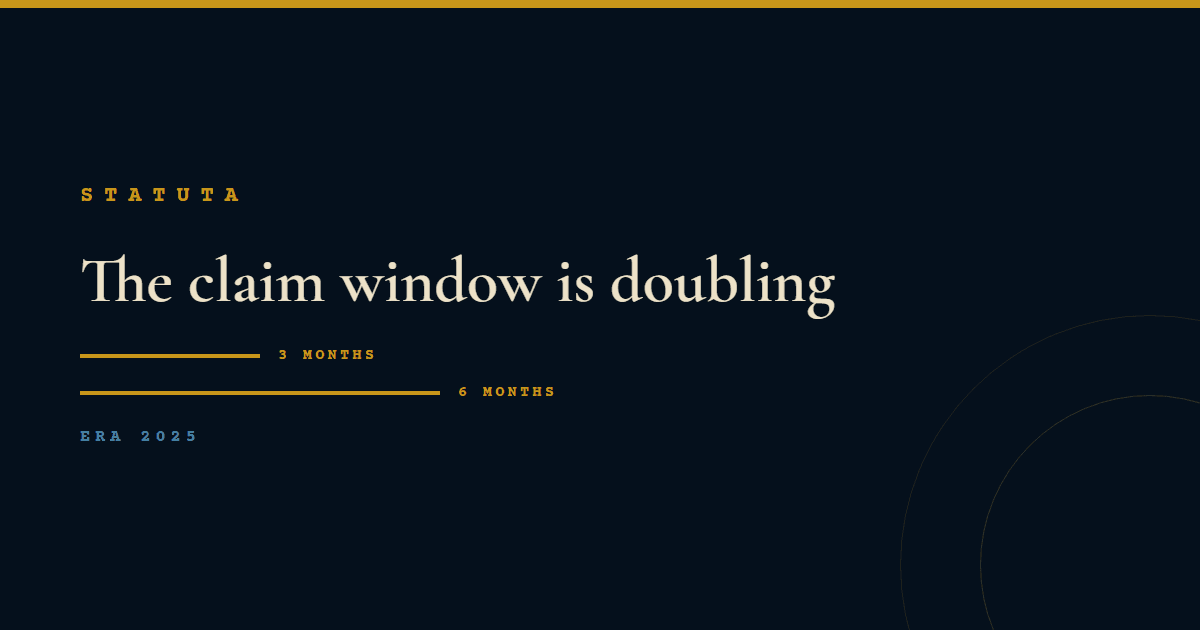
If someone leaves your business on bad terms, there has always been one small mercy: after 3 months, the risk of a tribunal claim mostly disappeared. You could stop holding your breath.
From 1 October 2026, that window doubles. Most employment tribunal claims will get a 6 month time limit instead of 3. It is one of the quieter changes in the Employment Rights Act 2025 (ERA 2025), and for small employers it may be the one with the biggest day-to-day effect.
In short:
- From 1 October 2026, the time limit for bringing most employment tribunal claims increases from 3 months to 6 months.
- That means every dismissal, redundancy, pay dispute and resignation carries live legal risk for twice as long.
- More time to claim generally means more claims, and more claims brought with legal advice.
- Your best protection does not change: fair process, contemporaneous records, and paperwork you can actually produce.
- Do three things this month: check your record keeping, review how you handle exits, and diarise the change for your managers.
What exactly is changing?
Right now, an employee who wants to bring most tribunal claims (unfair dismissal, discrimination, unlawful deduction from wages and others) must start the Acas early conciliation process within 3 months of the event they are complaining about. Miss the deadline and, with narrow exceptions, the claim is out of time.
The Employment Rights Act 2025 extends that to 6 months. The government's published implementation timeline confirms the change takes effect on 1 October 2026.
Three months was always tight. Someone who has just lost their job is dealing with money worries, job hunting and, often, the emotional fallout. Plenty of arguable claims died on the deadline. Parliament decided that was an access to justice problem. Whatever you think of the policy, the practical effect for you as an employer is simple: the risk tail on every employment decision just got twice as long.
Why this matters more for small businesses than big ones
Large employers have HR teams whose whole job is documenting decisions. When a claim lands 5 months after a dismissal, they pull the file.
In a 12-person business, "the file" is often a WhatsApp thread, a half-remembered conversation in the car park, and an email you think you sent. That was survivable when claims arrived within 3 months and memories were fresh. It is much less survivable when the claim arrives half a year later, the manager involved has left, and the tribunal hearing itself happens a year after that.
Tribunals decide cases on evidence. The side with the contemporaneous paper trail usually wins the factual disputes. A longer claim window widens the gap between employers who keep records and employers who rely on memory.
Will there actually be more claims?
Almost certainly. Three things point the same way:
- Simple arithmetic. Claims that currently fail because the person missed the deadline will now be in time.
- More time to get advice. A 6 month window gives ex-employees time to see a solicitor, and gives no-win-no-fee firms time to find them.
- The wider ERA 2025 direction. This change lands alongside a bigger package. From January 2027 the qualifying period for unfair dismissal drops from 2 years to 6 months, and the cap on compensatory awards is removed. The whole system is tilting towards more claims being possible, by more people, for more money. Our guide to ERA 2025 for small businesses covers the wider picture.
Employment tribunals are already carrying a heavy backlog, so cases will take longer to be heard too. Longer window, longer wait, fainter memories. Records win.
What this means for how you run exits
None of the following is new law. It is old law that just became more important.
Dismissals. Follow a fair process every time, even for short-service staff, even when the outcome feels obvious. Warn, meet, listen, decide, confirm in writing, offer an appeal. And from January 2027, short service will stop being the safety net it used to be anyway.
Redundancies. Keep your selection criteria, scoring and consultation notes. Six months later, "we scored everyone fairly" is an assertion. A dated scoring matrix is evidence.
Resignations. Constructive dismissal claims, where someone resigns and says your conduct forced them out, are exactly the sort of claim people currently run out of time to bring. Take exit grievances seriously and respond in writing.
Pay and deductions. Wages claims are high volume and easy to bring. Keep payslips, hours records and any deduction agreements tidy and retrievable.
References and post-exit contact. The dispute is no longer over when they walk out the door. Keep post-employment communication professional and consistent for at least 6 months.
What to do this week
- Pick your last three leavers. Could you produce, today, the documents showing why and how each exit happened? If not, that is your gap.
- Create one place, a folder per employee at minimum, where every meeting note, warning letter and exit document lives.
- Tell anyone who manages people about the 1 October change, in one sentence: assume every exit can come back at us for 6 months, so write things down.
- Review your disciplinary and grievance procedure against the Acas Code of Practice on disciplinary and grievance procedures. If you do not have one in writing, fix that first.
- Diarise a note: from January 2027, unfair dismissal rights kick in at 6 months' service and the compensation cap goes. Your 2026 processes need to be ready before then.
This article explains UK employment law in plain English. It is general information, not legal advice. For advice on your specific situation, speak to a solicitor.